

2025/2026 Trump Talking Points
In a nutshell: President Trump is not trying to govern. He is trying to rule. The list of examples of the Trump administration’s authoritarian actions keeps getting longer and longer.
Bypassing Congress and the Constitution
Taking military action against Iran and Venezuela, and striking suspected drug boats in the Caribbean and Pacific, without seeking or waiting for congressional authorization — even as Congress voted on (and narrowly rejected) resolutions demanding he do so.
Imposing sweeping global tariffs by executive fiat under a law never intended for that purpose — and losing. In February 2026, the Supreme Court ruled 6-3 that the law Trump invoked (IEEPA) does not authorize a president to impose tariffs at all, striking down roughly $175 billion in collected duties.
Bypassing Congress's constitutional power of the purse by unilaterally withholding or clawing back funds Congress had already appropriated, including the dismantling of USAID's programs before any law authorized it.
Declaring a national "invasion" at the southern border to justify using the military for domestic law enforcement — a use of the armed forces normally barred by law absent an actual declared emergency of that kind.
Eliminating the Referees
Firing at least 19 independent inspectors general in the first weeks of the term, without the 30-day notice or written justification the law requires — several of them shortly after their offices published findings critical of the administration. A Senate committee found the fired IGs had collectively uncovered billions of dollars in fraud, waste, and abuse.
Replacing ousted inspectors general with officials who have direct personal or political ties to the administration, undermining the independence the position is designed to guarantee.
Ignoring and violating federal court orders — including a Supreme Court order to facilitate Kilmar Abrego Garcia's return from a Salvadoran prison, which the administration delayed for two months — while the president calls judges who rule against him "radical left" and "a lunatic."
Denying individuals, including U.S. citizens, their Fifth Amendment right to due process before detention or deportation.
Deception and Loss of Public Trust
Publicly blaming ICE shooting victims for their own deaths — claiming they "weaponized" vehicles or attacked federal agents — in cases where video, eyewitness accounts, or DHS's own internal review later contradicted the official story. In one Minneapolis case, DHS admitted its own agents "appear to have made untruthful statements" under oath after the DOJ had already filed charges based on their account.
Claiming for weeks that "vandals" had slashed the newly renovated Lincoln Memorial Reflecting Pool with a knife or razor — a claim the president repeated with escalating, shifting figures (150 feet, then 250, then 300, then 350) — and criminally prosecuting a former Olympic athlete over it, before the administration quietly admitted in a court filing that the damage was actually caused by a botched contractor installation.
A documented pattern of officials asserting things directly contradicted by video or physical evidence, then declining to retract the original claim even after the correction becomes public.
Fear and Coercion Aimed at Individuals
Instilling fear in citizens and immigrants alike by having immigration enforcement personnel wear masks, use unmarked vehicles, refuse to identify themselves, and detain people — including U.S. citizens — without due process.
Deploying military and National Guard forces to American cities over the objections of the governors and mayors of those cities, who neither requested nor said they needed that presence.
Conducting lethal strikes on suspected drug-trafficking boats in international waters — reportedly killing more than 115 people by early 2026 — with the president, rather than any court, effectively acting as judge, jury, and executioner.
Punishing Critics, Rewarding Loyalty
Repeatedly labeling political opponents and critics "the enemy from within" and floating the use of the National Guard or military against them — rhetoric that, since taking office, has been followed by actual domestic deployments of forces to cities run by his political opponents.
Expecting the Justice Department to investigate and prosecute individuals the president perceives as having wronged him personally, rather than operating independently of the White House.
Prioritizing personal loyalty over qualifications in cabinet and senior appointments, with willingness to embrace the false claim that the 2020 election was stolen functioning as an informal litmus test.
Continuing, years later, to publicly deny the outcome of the 2020 election and to claim without evidence that Democrats rig elections.
Pardoning or commuting the sentences of January 6th defendants, including people convicted of violently assaulting police officers.
Curbing the Press and Free Speech
banning journalists from CNN, MS NOW, and Politico from entering the White House (9/19/26)
Removing the Associated Press and Reuters from their standing rotation in the White House press pool, and withholding official pool reports that contained information the White House found "inconvenient" — restricting the public's access to independent, wire-service coverage of the presidency.
Using lawsuits, threats to pull federal funding, and threats of regulatory retaliation to pressure universities and media organizations into policy changes — including freezing billions of dollars from Harvard and Columbia over disputes about campus speech and protest policy.
Firing thousands of federal employees, in many cases without the legally required cause or process — actions multiple courts have already found unlawful, with litigation ongoing over others.
2025/2026 Alaska Congressmen Talking Points
In a nutshell: Alaska's Sen. Dan Sullivan and Rep. Nick Begich have had repeated opportunities to check executive overreach — and in nearly every case, they've chosen not to. While Sen. Lisa Murkowski has broken with the administration on several of these votes, Sullivan and Begich have not.
Enabling war without congressional authorization
Sullivan has voted against War Powers Resolutions to end the unauthorized war with Iran at least seven times since the conflict began in February 2026 — more than any other check Congress attempted on that war. Begich voted against the House version of the same resolution.
In November 2025, Sullivan was one of only a handful of Republicans to vote against even allowing debate on a resolution to stop unauthorized U.S. bombing of Venezuela; Murkowski voted the opposite way.
After U.S. forces captured Venezuelan President Nicolás Maduro in a January 2026 operation that surprised even Congress, Sullivan publicly praised the operation as making "America and the world safer," and a Begich spokesperson called it "a lawful execution" — before any congressional authorization vote had taken place and while Murkowski was still publicly questioning the operation's legality.
Sullivan's own office has defended these votes by citing the president's Article II authority rather than requiring Congress to weigh in first — effectively ceding, rather than defending, Congress's constitutional war-declaration power.
Funding the enforcement apparatus
Sullivan voted for a $69.5 billion reconciliation package in June 2026 to fund ICE and Border Patrol operations through 2029 — money that has directly funded the enforcement tactics documented earlier in this series, including unmarked vehicles, masked agents, and detentions without due process.
Begich voted in March 2026 for the "Pay Our Homeland Defenders Act," restoring full DHS funding after a lapse — funding the same agency whose officers have been found to have made false statements about fatal shootings.
Silence on accountability and oversight
Neither Sullivan nor Begich has publicly opposed or called for reversal of the administration's firing of 19 independent inspectors general — watchdogs whose removal a Senate committee found eliminated offices that had collectively uncovered billions of dollars in fraud, waste, and abuse.
At a Juneau Chamber of Commerce event, Begich reportedly responded to constituent concerns about separation-of-powers violations by saying he would "let the courts decide" — even after courts had already ruled and the administration continued to resist those rulings.
Neither has joined Sen. Murkowski in publicly criticizing the administration's handling of due process violations, court-order defiance, or the concentration of power in the executive branch.
What their defenders would say
In fairness, Sullivan's office has offered a consistent rationale: it argues Iran has been a state sponsor of terrorism for decades, that presidents of both parties have used Article II authority to act against foreign threats without prior authorization, and that ending hostilities mid-conflict would send the wrong signal to adversaries. On enforcement funding, both argue that securing the border and deporting people with criminal records are longstanding, broadly popular priorities separate from concerns about individual agency conduct. And to be fair to both, "not yet taking a public position" against the IG firings isn't the same as affirmatively defending them — it may reflect caution, deference to ongoing litigation, or simply not being asked, rather than approval.
The core argument
Whatever the individual justifications, the pattern across war powers, funding, and oversight is the same: when Congress has had a direct vote or a direct opportunity to check the executive branch, Sullivan and Begich have — with a few narrow exceptions — voted with the administration rather than with the constitutional role of their own branch. Murkowski's votes on the same measures show that a different choice was available to Alaska's delegation. Enabling isn't always an action — sometimes it's declining to use the power you have.
Recommended sources of current information and opinions from substacks, podcasts, and TikTok
SUBSTACKS
Van Abbott (Ketchikan resident and political commentator) website: http://politicalwinds.org
Paul Krugman (economist)
Robert Reich (Seretary of Labor under President Clinton)
Heather Cox Richardson “Letters from an American” (historian)
PODCASTS
The David Frum Show (former speech writer for George W. Bush)
The Coffee Klatch with Robert Reich
Mallon Baker (British commentator)
TikTok
Aaron Parnas (popular Gen Z journalist) also has a substack
Citizens React
Americans show up,
concerned about the over 100 executive orders signed in Trump’s first days in office, many of which are unconstitutional or unlawful.
Bernie Sanders and Alexandria Ocasio-Cortez address large crowds in April
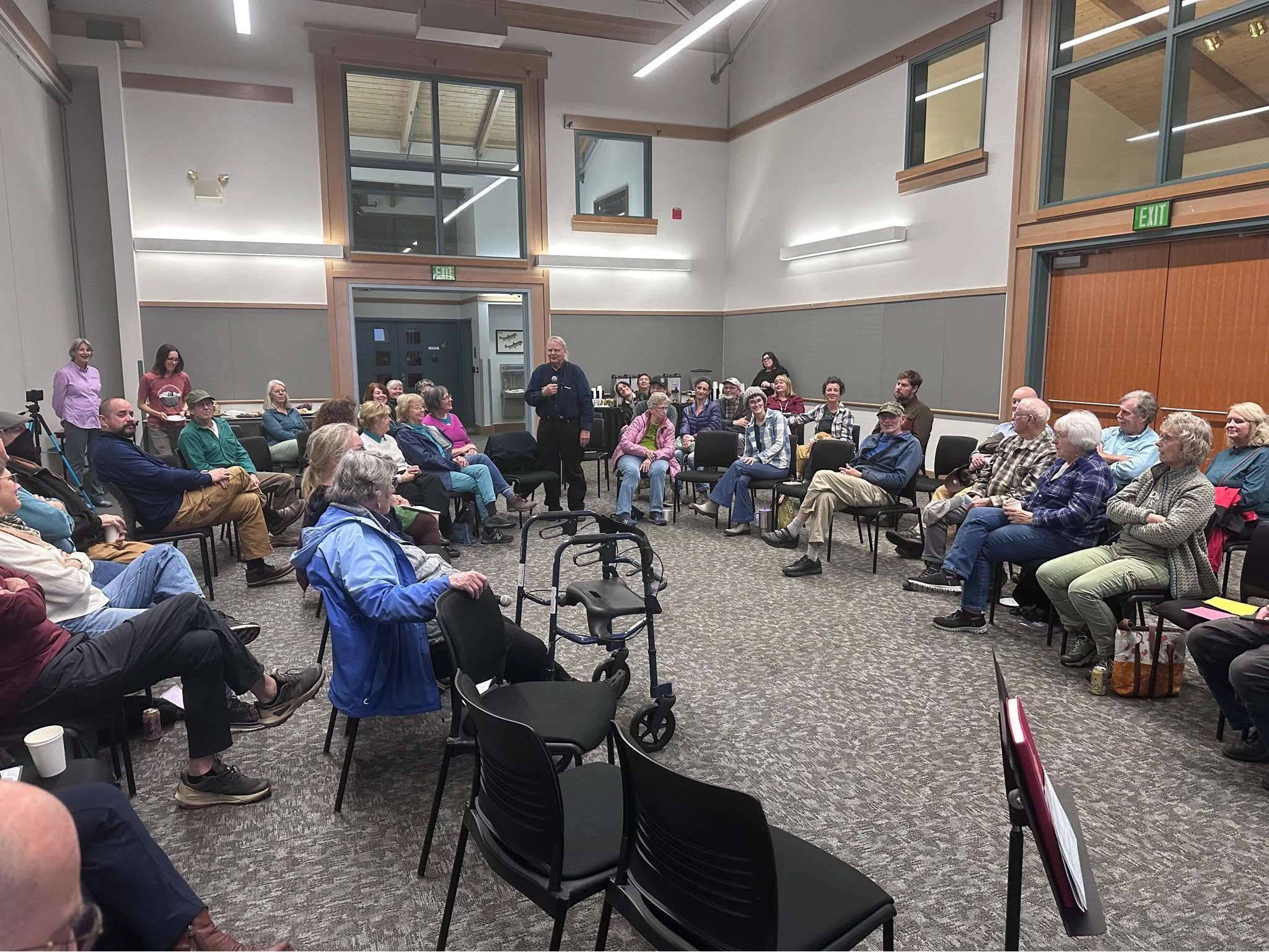
Voices for Reason holds a Town Hall
to assess the effects on Ketchikan of the Trump Administration’s actions, the One Big Beautiful Bill, and the Rescissions Act of 2025. The town Hall was held on October 8, 2025. See the report
Ketchikanites at Town Hall
Citizens are protesting.
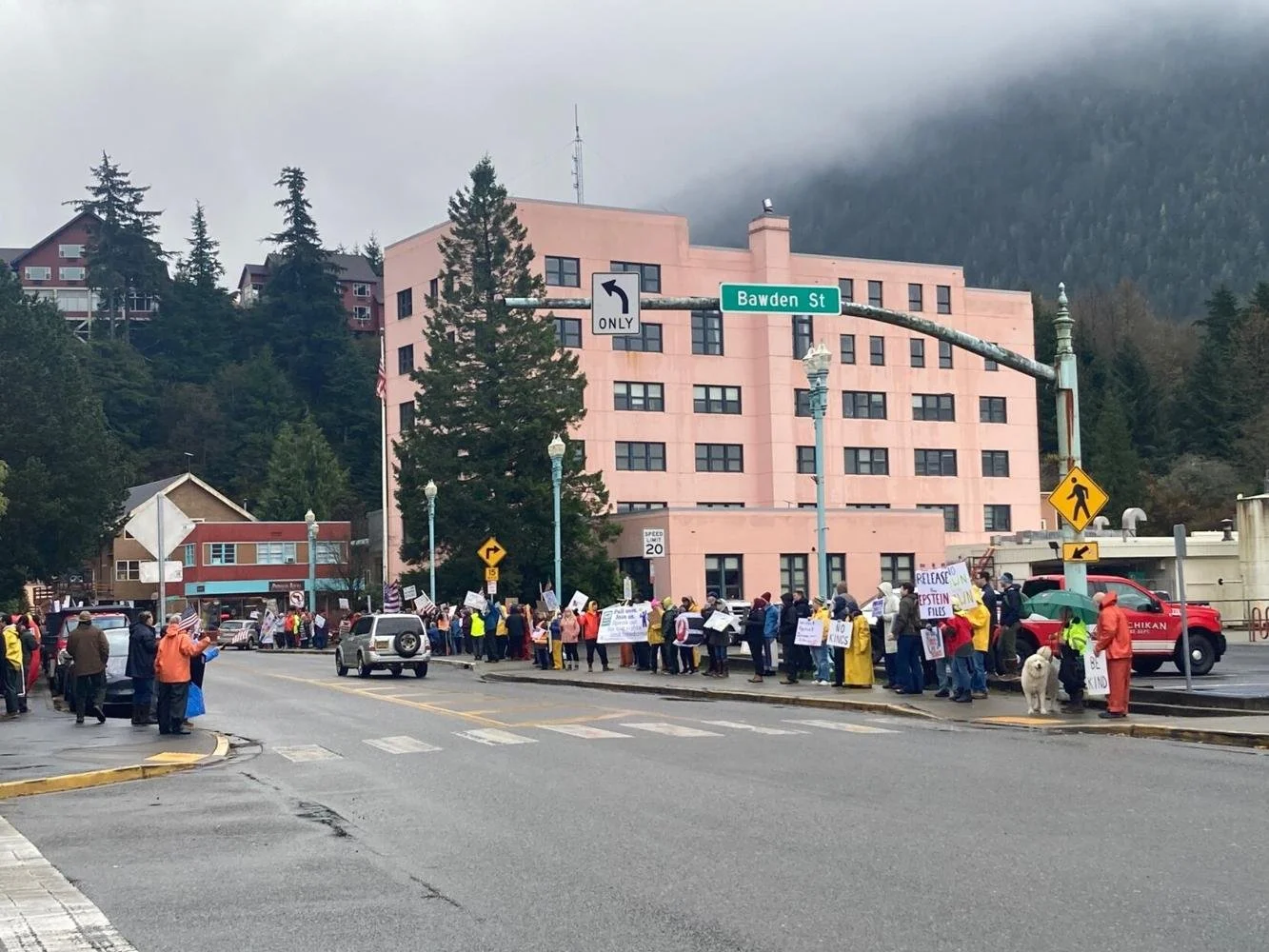
On October 18, 7 million people attended No Kings rallies in all 50 states. In Ketchikan, 300 people assembled to peacefully demonstrate to the government and the nation that most Americans do not want our democracy to turn into an autocracy. See the Ketchikan Daily News article for details of the local event.
No Kings protest/march/rally in Ketchikan
2024 Talking Points
Donald Trump is Undemocratic
The founding fathers were exceptional in establishing a constitution that gave power to regular people, instead of kings and emperors. The functioning democracy they created has lasted over 240 years. Trump’s statements about potentially rigged elections before the 2016 and 2020 elections, and then calling the 2020 election “stolen,” are undemocratic and have greatly reduced Americans’ trust in the legitimacy of the electoral process. Donald Trump’s “I alone can fix it,” sounds like an autocrat, not the leader of a democracy designed with checks and balances, and a government of the people, by the people and for the people.
Donald Trump is Unpatriotic
A patriot running for president would say that he will accept the result of the 2024 election, no matter who wins. Trump did not commit to accept the election result in 2016 and 2020 and he has refused to commit to accept election results in 2024. Trump shows great disrespect for all government institutions and anybody who doesn’tagree with him. This has greatly polarized the country, eroding our trust in each other, our longstanding institutions, and the country’s abilities to solve problems. This is not the speech of a patriot. Trump calls the January 6 felons in jail “patriots,” many of whom were convicted of attacking capitol guards. He calls real patriots who served or died while in the US military “losers” or “suckers.” This is not the posture of a patriot.
Donald Trump is Dangerous
Trump is a danger to our country. On January 6, 2021, thousands of people rioted in and around the US Capital. Many of these people were acting out of a sense of patriotic duty or loyalty to Donald Trump, believing in his lies that the election was stolen. Trump did not send these folks to the capital to protest. They were sent to intimidate congressmen and bully the Republicans, and especially Mike Pence, into not certifying the election. He made no attempt to stop the rioters for more than three hours, and not until the National Guard and police had controlled the violence and chaos. We have learned this "protest" was only one part of Trump's plan to stay in power. He also secretly organized a set of fake Electoral College electors in battleground states. And he attempted to strong-arm Republican election officials to call into question the fairness of the election or to "find votes."
The Electoral College vote was very close. It was close enough in the battleground states that maybe Trump would have won on another day, but he didn't in the election of 2020. The rules for that election were made by elected government officeholders and/or officials appointed by those elected officeholders. Those were the rules. Trump lost. He should have accepted the defeat, congratulated the winner, and moved on as is the norm and as we teach our children to do. After the Supreme Court sided with Florida in 2000, Al Gore accepted his defeat in a much closer and legally contestable election. Al Gore did this for the good of the country. He was being a patriot. Trump is not. We can not have a functioning constitutional democracy if our citizens don't believe our electoral process is legitimate. How can power be transferred peacefully without citizens trusting the results of our elections?
Not only did Trump betray the Constitution in his attempted coup in 2020, but he continues to delegitimize our electoral process. He accuses Democrats of trying to rig the 2024 election, and he makes no attempt to discourage violence by his supporters. He is dangerous. He can not be our next President.
Millions of Americans have sacrificed their time, their energy, and even their lives to protect and preserve our democracy. We owe it to these patriots, our founding fathers, our children, and ourselves to help safeguard America’s institutions of self-governance.
Importance of Democracy
Ketchikan Daily News letter to the editor by VFR PAC member Bill Rotecki:
I served on the Ketchikan Borough Assembly from 2000 to 2006. That experience of governing in accord with democratic principles reinforced my belief that democracy, and democratic institutions, work. The Assembly members often did not agree on the policy decisions and the actions we took. But all of us had an equal opportunity to express ourselves, listen to other points of view and try to persuade other members that a certain approach was best for the borough. Those processes were open to the public, and the public had genuine opportunities to weigh in and influence our decisions.
And through this process, we served the people of Ketchikan.
As I’ve experienced the blessings of liberty over a long life, I have had the good fortune to travel around the world and visit democracies and kingdoms, countries both wealthy and impoverished, and this has led me to appreciate the system we have here at home. At home I’ve frequently worked for the adoption of public policies I favored, and opposed some that I didn’t favor.
I’ve won some and lost some. Yet, I’ve always believed that, however imperfect, and whatever the wins and losses, the principles and benefits of democratic self-government were a rock-solid foundation to our lives as Americans — the foundation for American exceptionalism. What worries me now is that many of my fellow citizens seem ready to abandon that democratic foundation and replace it with a system where self-interest, power and wealth for a few are more important than working for the good of us all.
I believe that if you want both freedom and a government that is responsive to the needs of its citizens, you must have democracy and a dedication to democratic institutions. Authoritarian countries may serve the material needs of their citizens, but the price you pay is the sacrifice of freedom of thought, freedom of expression, freedom of worship and so on. Citizens of our great country should think long and hard before sacrificing our democracy and democratic institutions for that bargain.
What was Trump like as a president in his first term?
-
Trump's presidency was marked by increased division in the country. There was a record uptick in hate crimes during his time in office.
-
Under Trump's administration, there was a record increase in homicides in 2020. Despite numerous mass shootings, Trump took no significant action on gun control.
-
Trump made controversial remarks about the Charlottesville rally, seeming to equate neo-Nazis with counter-protesters. He also associated with extremist groups, notably expressing support for the Proud Boys during a presidential debate.
-
Trump's judicial appointments, particularly to the Supreme Court, led to the overturning of Roe v. Wade. His nomination of Brett Kavanaugh to the Supreme Court was highly controversial due to sexual assault allegations against the nominee.
-
Trump has been convicted of multiple felonies related to his time in office and his conduct outside of office, including charges stemming from falsifying business records.
-
Trump's administration was heavily criticized for its mismanagement of the COVID-19 pandemic. He dismantled pandemic preparedness infrastructure early in his presidency, which may have hampered the initial response to the outbreak.
-
Despite his promises, Trump's presidency saw net job losses. The national debt also increased significantly during his term, partly due to tax cuts for corporations and wealthy individuals.
-
There were numerous ethics concerns during Trump's presidency, including allegations of profiting from his position. He also appointed family members to high-level positions in his administration, raising concerns about nepotism.
-
Trump implemented a controversial family separation policy at the southern border. He also attempted to ban entry to the U.S. from several predominantly Muslim countries, a move that was widely criticized as discriminatory.
-
Trump made contentious decisions regarding Israel and Palestine, including moving the U.S. embassy to Jerusalem. There were also allegations that he sought foreign interference in U.S. elections.
-
Following his loss in the 2020 election, Trump promoted false claims of election fraud. His actions and rhetoric are believed to have contributed to the January 6th attack on the U.S. Capitol.
-
Trump is the only U.S. president to have been impeached twice. The charges included abuse of power and incitement of insurrection.
-
Trump had public disputes with the U.S. intelligence community over Russian interference in the 2016 election. There were also allegations that he obstructed investigations related to Russian interference.
-
During his presidency, Trump withdrew the United States from the Paris Climate Agreement. His administration also rolled back numerous environmental protections.
-
Trump attempted to repeal the Affordable Care Act without a clear replacement plan. His proposed budgets included cuts to Medicare and Social Security, despite campaign promises to protect these programs.
-
After leaving office, Trump was alleged to have improperly retained classified documents, including some reportedly containing sensitive national security information.
-
Throughout his presidency, Trump was known for making frequent false or misleading statements. His administration was also criticized for its response to natural disasters, particularly in Puerto Rico following Hurricane Maria.